The convergence of traditional and onchain finance has increased the stakes. With institutional-size capital in play, expectations are higher and risk tolerance is lower. Vault curators have to meet the bar in onchain markets that never close, have no undo button, and make the technology inseparable from the vault itself.
In TradFi, stress testing and pre-trade checks have been essential steps in risk modeling. In DeFi, teams have simulated protocol behavior against live conditions for years, testing parameter updates, oracle deviations, and market shifts before executing them.
These practices now converge into a requirement for every vault moving institutional capital at scale: risk modeling as the operational standard. As the simulation company for onchain operations, Tenderly is the infrastructure that makes this standard possible onchain.
Operating vaults goes beyond current state analysis
Full data availability is one of blockchain’s greatest advantages. You can see exactly what’s happening in real time. You can follow liquidity flows, see which addresses are involved, and fetch market history since the beginning of (blockchain) time.
However, this openness and composability bring challenges that have no equivalent in traditional systems. Aside from often requiring deep technical expertise in addition to financial knowledge, onchain products are built from third-party DeFi primitives, which means a vault’s behavior depends on the protocols underneath it, the oracles feeding it prices, and the other vaults sharing its markets.
The very nature of the blockchain environment brings another limitation. The code you audit isn’t the same as the system you run. Visibility into the current state tells you only how your vault behaves at this point in time. It can’t tell you how your vault will behave under potential market conditions, dependency failures, or strategy shifts. And risk multiplies with every protocol a vault integrates and every market it participates in, across chains.
Three non-negotiables across the vault lifecycle
Running vaults in such a dynamic environment requires managing risk throughout their entire onchain lifecycle, from creation and capital deployment to ongoing management to stress testing against worst-case scenarios. A curator has to understand a vault's mechanics closely enough to predict its behavior in situations that haven't happened yet, know where the structure breaks under pressure, and ensure depositors can exit if it does.
Across that lifecycle, three prerequisites become non-negotiable as part of ongoing risk management onchain:
- Ensure production readiness: Validate vault launches, integrations, and allocations against the real state of every chain you operate on before anything reaches production.
- Maintain operational integrity: Dry-run daily operations before signing them. Monitor oracles, positions, and capital movements continuously. Test new markets on live flows before committing real capital.
- Evaluate and mitigate risk continuously: Model price crashes, frozen oracles, and whale exits. Then, validate incident responses before you need them and contain damage the moment it starts.
Tenderly makes modeling the operational standard
Each of these prerequisites requires understanding vault behavior and performance beyond current-state analysis. You need to see how your vaults will behave under market conditions that haven’t happened yet. Tenderly lets you model risk against historical, current, and future states at every stage of the vault lifecycle:
- Simple-operation previews: See the outcome of moving capital into a vault under a specific parameter set, including resulting positions, profit and loss, and rates, before anyone signs. These are fast checks for routine, lower-stakes decisions.
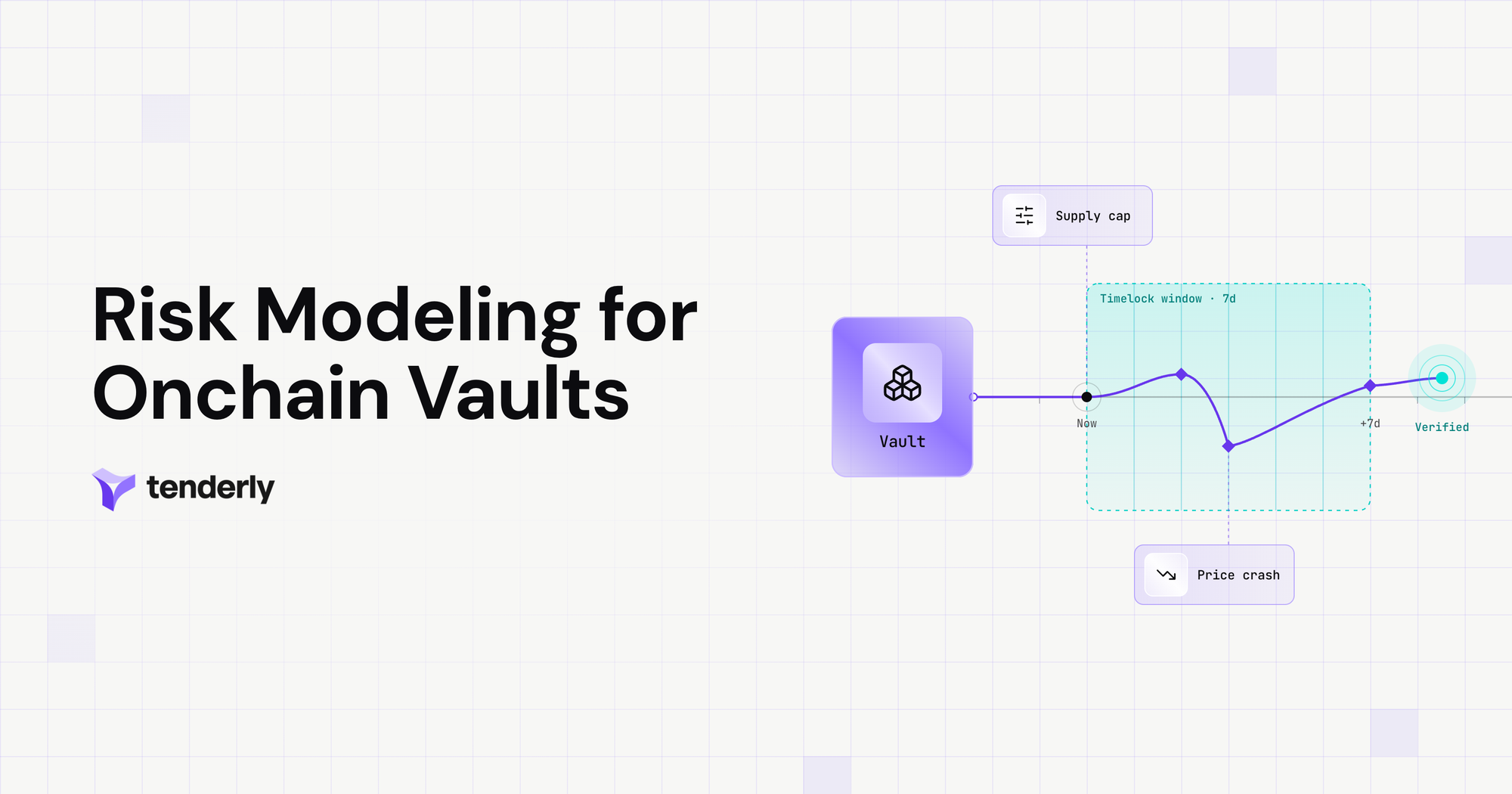
- Performance modeling under production conditions: Evaluate vault performance after making parameter changes in a mirrored copy of a live chain, with live state, real oracle prices, and actual dependencies. Play a parameter change forward through its timelock window and see how the vault performs against real market conditions before approving the change in production.
- Worst-case scenario modeling: Break the vault on purpose. Model worst-case scenarios such as a price crash, frozen oracles, or whale exits. Surface bad debt, locked positions, and exit constraints that aren’t available in current-state dashboards.
Then run all of it across chains. A vault that holds on one network can fail on another, so model cross-chain messages and strategy execution as a single sequence in one environment. Identify losses and failures that would otherwise go unnoticed.
Modeling comes first, monitoring comes after
Modeling lets you anticipate vault performance against potential market states or worst-case scenarios. But the work isn’t done once your vault is live and capital starts moving through markets.
You need to keep monitoring its behavior to surface deviations early. Track oracle freshness, utilization near caps, exit capacity, allocation drift, and large withdrawals. The moment you catch a deviation from the expected state, run the incident response to contain damage before it spreads across positions, markets, and chains.
Together, simulation and monitoring form a validation layer for managing risk across the entire lifecycle, while providing a verifiable record that curators can hand to allocators, depositors, and regulators.
Operate vaults with a verified, observable model
Stress testing, pre-trade checks, and audit trails have been a critical part of traditional financial systems for years. They're now the operational standard for vault curation and management. The curators handling institutional capital are expected to show up with a proven model of vault performance and a record of diligence to back it up.
So, every time something changes, every time a parameter moves, and every time you ask "what if," don't stop at wondering how it would play out. Model it instead.